

The Beetrooter’s Dog
Forget the politics for a minute. Barnaby Joyce and his dog recently gave us about as honest a dog-training moment as you’ll ever see on television.
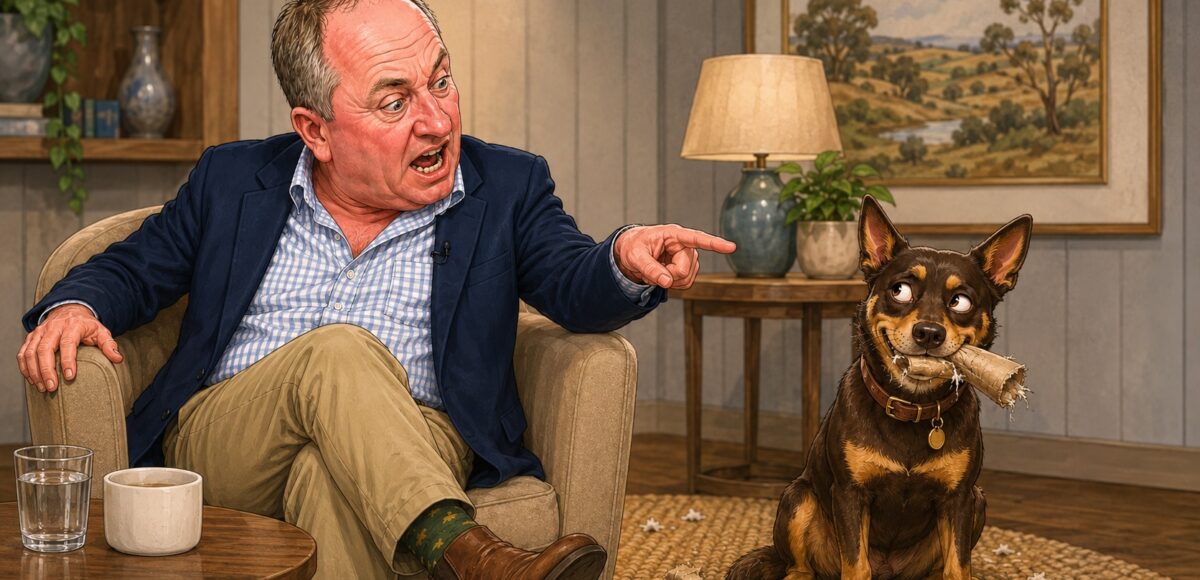
He was halfway through an interview on ABC’s 7.30. His dog was making a nuisance of itself off camera, Barnaby was trying to concentrate, and eventually out came a very firm “siddown!”
You can watch the original ABC interview clip here.
The clip took off because it was funny, a bit uncomfortable and instantly recognisable. Plenty of dog owners have had their own version of that moment. You put up with something, put up with it a bit longer, then suddenly respond at a level the dog probably didn’t see coming.
We only saw a few seconds, so this isn’t a judgement on Barnaby’s whole relationship with his dog. They may get along brilliantly. The interesting question is simply this: what did the dog learn?
Did the “siddown” work?
Maybe.
In dog-training terms, Barnaby’s response could be called positive punishment. That sounds as though somebody is trying to put a friendly spin on yelling, but the word positive just means something was added. In this case, a loud and unpleasant consequence was added after the dog’s behaviour, with the aim of stopping it.
There is every chance the dog connected Barnaby’s response with what it had just been doing. The behaviour may be less likely to happen again in the same situation.
There’s also a chance the dog simply stopped because Barnaby suddenly became loud and intimidating.
Those two outcomes can look exactly the same in the moment. The dog goes quiet, the owner gets relief and everybody assumes the lesson has landed. But one dog has understood that a particular behaviour brings a consequence. The other has just thought, “Something has gone badly wrong here.”
Dogs are good at noticing patterns, but they aren’t mind readers. Barnaby knew he was trying to conduct a serious television interview and had reached the end of his patience. His dog didn’t know any of that. It only experienced the final response.
It may have connected the outburst with barking or interrupting. It may have connected it with approaching Barnaby, the equipment in the room or simply being nearby when his mood changed. From a short clip, nobody can honestly say.
Barnaby is no Robinson Crusoe
This sort of interaction is extremely common, including among owners who otherwise have a great relationship with their dog.
The dog does something annoying. Nothing happens. It does it again. The owner gives a half-hearted “stop it”. The dog continues, because so far nothing particularly meaningful has changed. Frustration builds until the owner goes from doing almost nothing to doing everything at once.
The owner experiences a gradual build-up. The dog experiences an unpredictable explosion.
Most of the time a behaviour appears to be tolerated. Every now and then it produces a big reaction. The dog may start watching the owner’s mood rather than understanding the rule.
Have a system before you need one
The better option is to decide what you want the dog to do and teach that before you’re frustrated. Then practise when you aren’t already annoyed.
Reward the behaviour you want. Interrupt the unwanted behaviour early, before you’ve worked yourself into a state.
Beware of the Unpredictable Dog Owner
When the same behaviour keeps pushing you from mild annoyance to a major reaction, it’s worth looking at the system rather than simply blaming the dog.
Have you shown the dog what you want? Have you practised it outside the difficult situation? Do you respond the same way each time, or does it depend on your mood? Are you waiting until you’re already angry before doing anything?
Dogs need leadership and owners who are reasonably predictable.
If you need support for your next television interview…… contact Direct K9 Services. We can help you put a practical system in place so your dog understands what needs to change, without either of you having to wait until the next “siddown!” moment.